Egg-
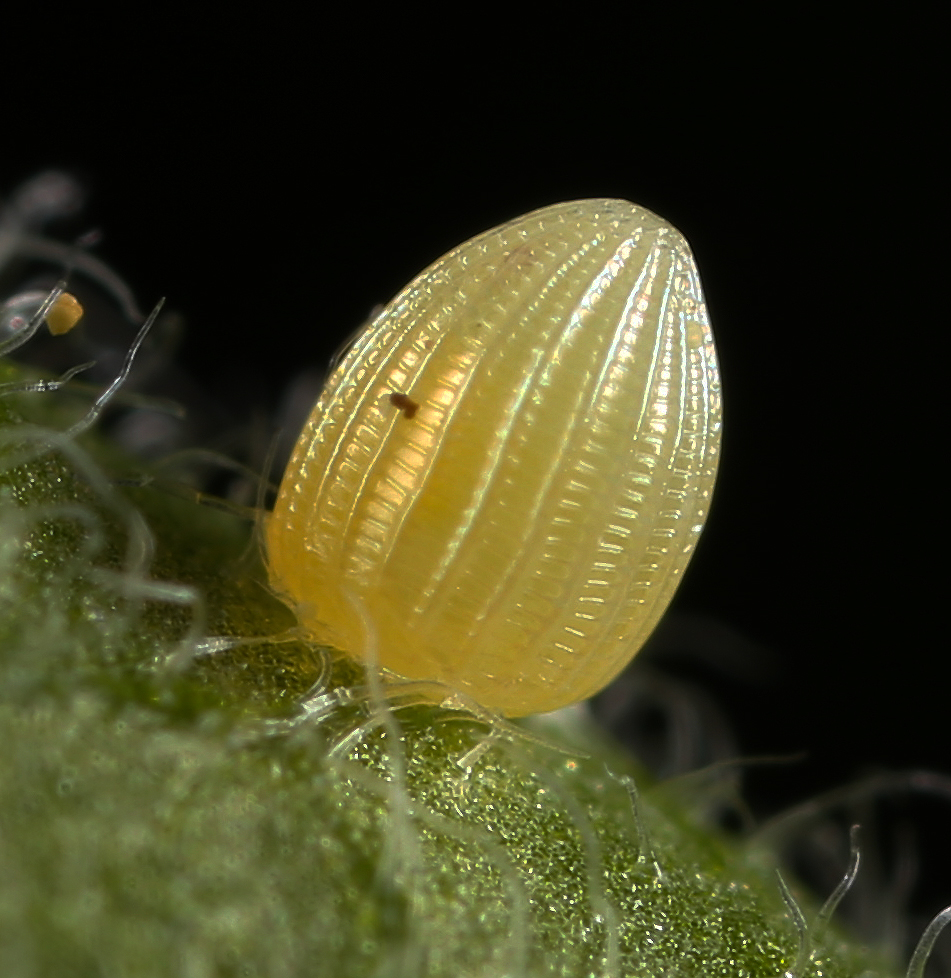
Monarch eggs are surround by a hard outer shell, this shell is called the chorion. The chorion job is to protect the growing larva inside the egg. A wax surface covers the chorion to keep the egg from drying out. The eggs have a small funnel-shapped opening on one end of the shell called micropyles. The eggs get their hard shell before they get fertilized, the micropyles lets the sperm enter the egg. Monarch eggs have small ridges on the out side of the egg. These ridges form before the egg is laid. Butterfly eggs vary in shape and size.
Lava-
The larva of the Monarch butterfly have three distinct body parts: the head, the thorax, and the abdomen. The head has a pair of short antennae, mouth parts (the lower lip, mandibles, and upper lip) and six pairs of eyes, called ocelli. Even though caterpillars have lots of eyes their vision is poor. Caterpillars use their antennae to guide themselves along with the maxillary palps, which are sensory organs, guide food to their jaws.
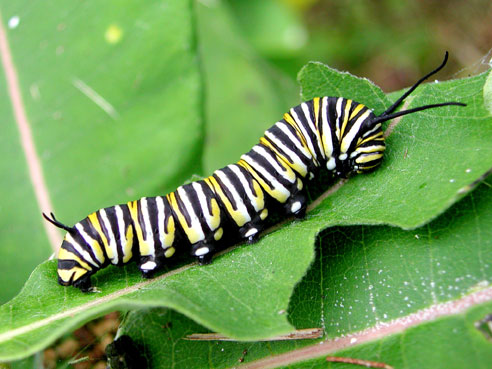
The thoracic segment has jointed, or true legs, while some of the abdominal segments have false leg, or prolegs. The proleg have tiny hooks at the end of the leg that helps the caterpillar stick to the leaf. Caterpillars have tentacles on the front and rear. the tentacles are not antennae but do function as sense organs. To receive oxygen Monarch caterpillars have holes on the side of their thorax and abdomen called spiracles. Spiracles are connected to air tubes called tracheae that travel al over the caterpillars body spreading air.
Pupa-
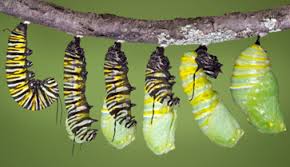
When the Monarch pupates its larva splits its exoskeleton and crawls out of its skin.When the skin is far enough down the body the cremaster show. The cremaster is a spiny appendage at the end of the abdomen. The Monarch hooks its cremaster to the silk pad the larva spun before pupating. The pupa will hang from the pad until it emerges as an adult. As the metamorphic process completes the Monarch looks like it goes through four distinct stages, but continuous change is happening inside the larva. The adult organs such as the wings develop from clusters of cells already present in the larva. By the time the larva pupates the major changes are already in progress and are completed in the pupa stage. The pupa will spin a cocoon to protect its self, the cocoon is called a chrysalis.
Adult-
The body of an adult butterfly is divided into the same major parts as the larva-head, thorax, and abdomen. There are four main structures on the adult head: eyes, antennae, palpi, and proboscis.
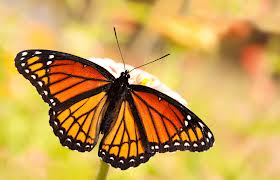
A butterfly’s relatively enormous compound eyes are made up of thousands of ommatidia each of which senses light and images. The two antennae and the two palpi, which are densely covered with scales, sense molecules in the air and gives butterflies a sense of smell. The straw-like proboscis is the butterfly’s tongue, through which it sucks nectar and water for nourishment. When not in use, the butterfly curls up its proboscis.
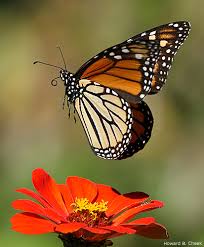
Three segments make up the thorax. Each segment has a pair of legs attached to it, while the second and third segments each have a pair of wings attached as well. The legs consist of six segments. They end in tarsi (singular, tarsus, which grip vegetation and flowers when the butterfly lands on a plant. Organs on the back of the tarsus “taste” sweet liquids. Monarchs (and other nymphalid butterflies) look like they only have four legs because the two front legs are tiny and curl up next to the thorax.
All butterflies and moths have four wings, two hindwings and two forewings. Small structures attach the wings to the thorax, and muscles attached to these structures move the wings. The butterfly can also move its wings by changing the shape of its thorax. Wing veins, tubes with thickened walls, contain trachea, nerves, and space for hemolymph to move through. Veins give the wings structure, strength, and support.
The abdomen consists of eleven segments, the last two or three of which are joined. On male Monarch butterflies you can see a pair of claspers on the end of the abdomen. These appendages grasp the female during mating.
For more information visit Monarchlab.org, Monarchbutterflyfund.org, and Flight of the butterflies